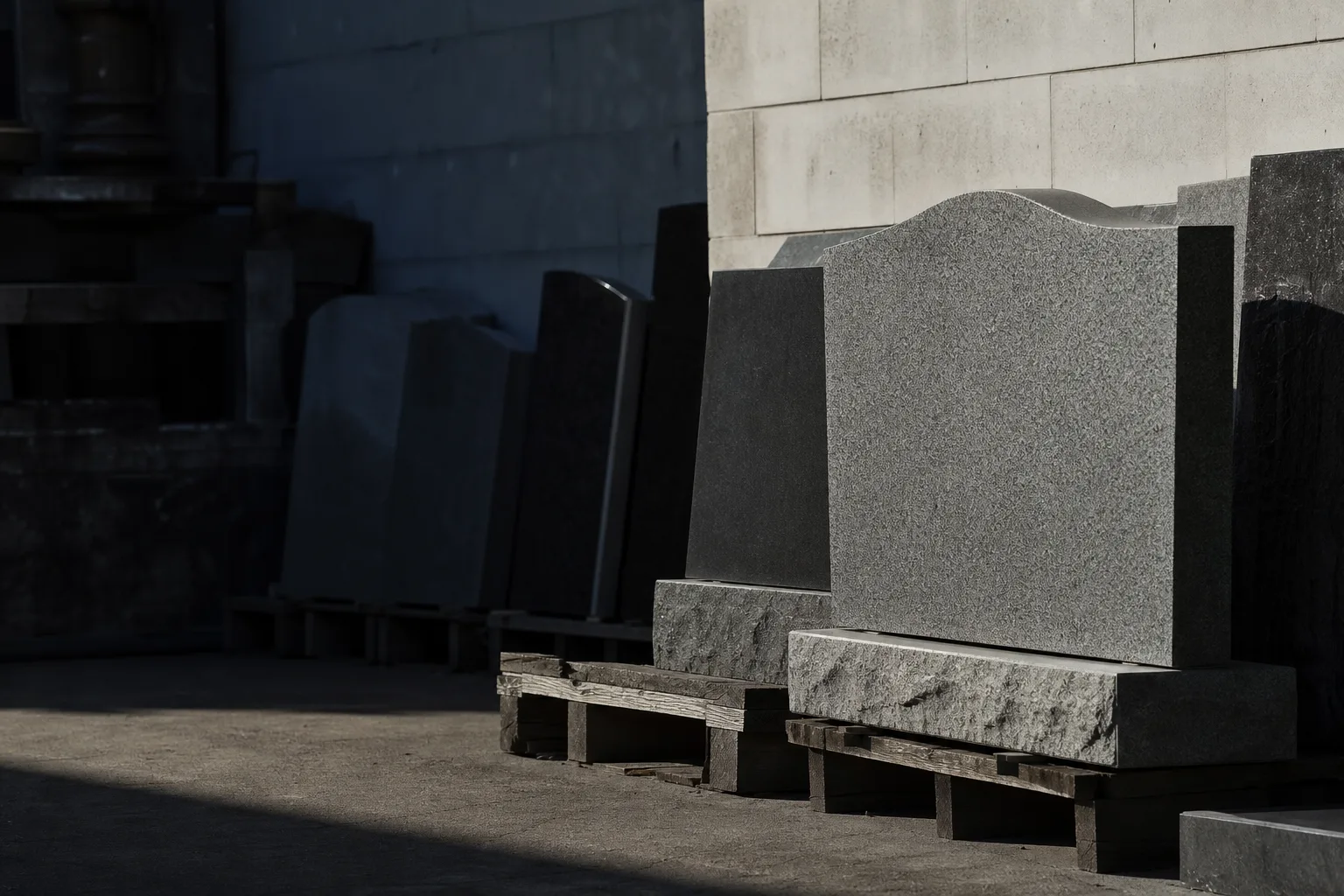
Ground settling, cemetery permit, dealer, proof, foundation, setting: the six stages of ordering a grave marker, what each one decides, and where the money goes.
Most families order a monument later than they expect to, and later than they were braced for, which comes as a relief once the reason is clear rather than a source of guilt. The grave is closed, the funeral home's work is finished, and the next call is not to a carver but to the cemetery office. Between that closing and a stone standing upright over it, six things happen in a fixed order, and each one asks the family to decide something specific. Skipping a stage rarely saves time. It usually costs money later, in reset fees, revised proofs, or a marker that has to be lifted and leveled a second season.
The ground settles first, and that is not a delay anyone invented
Fresh backfill compacts unevenly for months, and how many months depends on soil, drainage, depth, and whether the grave was opened in frozen ground or in August. A monument set on unsettled fill tilts, and once it tilts the correction is a paid service call: lifting the stone, rebuilding the base, resetting it plumb. Cemeteries usually name a waiting period in their own rules, often expressed as a season or a set number of months, and enforce it whether or not the family agrees. The comparison worth holding is between waiting six or eight months at no cost and paying a resetting charge two years on, which is real money for work that was avoidable.
The cemetery permit sets the outside edge of every later choice
Before a dealer can quote anything meaningful, someone has to obtain the cemetery's written specifications for that section: maximum height and width, permitted materials, whether flush markers only, whether upright monuments are allowed, base dimensions, and the foundation standard the cemetery requires. Some cemeteries charge a permit or setting fee, some charge a foundation fee separately, and a few charge both. The family decides here between the design they pictured and the design the section permits, and that is the cheapest moment to discover the difference. A dealer who quotes an upright monument for a flush-marker section has quoted a stone that will be refused at the gate.
Choosing the dealer is a comparison of what the quote includes, not the stone alone
Two quotes for the same granite in the same size can differ by hundreds of dollars because one carries the foundation, the setting, the cemetery permit and the sales tax while the other carries the stone and the lettering. Ask each dealer to write out, on the quote, who pours the foundation, who pays the cemetery, how many lines of inscription are included, and what a later date addition would cost when the second name is added. Prices for headstones move with material, size, the number of polished faces, and the amount of hand carving, so the useful comparison is between two fully specified quotes rather than between two headline figures. The Federal Trade Commission oversees consumer protection in the sale of funeral goods and services, and its general expectation, that buyers get itemized prices rather than bundles, is the standard to hold a monument quote to as well.
The proof is the last free revision, and it deserves an afternoon
After the order, the dealer produces a drawing or a digital rendering showing the exact layout: name spelling, dates, the shape of the letters, the placement and depth of any emblem or portrait, the line breaks. Once that proof is approved and signed, changes are billable, and a stone already sandblasted is not correctable in any real sense. Read it aloud with a second person, check the middle initial against a document rather than memory, check the year of birth against the death certificate, and check the placement of the second name if a spouse is living. Families who take two days over the proof almost never pay for a revision. Families who approve it by text in a parking lot sometimes do.
Foundation and setting are separate jobs, often by separate hands
The foundation is a poured concrete base sized to the monument and set below the frost line, and depending on the cemetery it is poured by the cemetery's own crew at a published rate or by the dealer to the cemetery's specification. Setting is the crane or tripod work that places the stone, levels it, and seals the joint. Both are weather dependent, so an order finished in November may sit in a shop until the ground opens in spring, which is worth asking about before signing rather than after. The family's decision here is small but real: whether to pay the cemetery's foundation rate for the convenience of a single point of accountability, or the dealer's, which is sometimes lower and sometimes not.
Counted end to end, the sequence runs longer than the first weeks and shorter than the fourteen months a badly ordered stone can take. Settling waits on the season. The permit waits on a phone call someone has to make. The proof waits on an afternoon of careful reading, and the setting waits on the ground being open. Every stage has a decision in it that is cheaper made once, made early, and made in writing.