One family's stone took fourteen months and three revisions to get right, mostly because nobody explained the order things happen in. What follows is the order, and the questions worth asking at each step.
Two quotes for what looks like the same stone can differ by a third, and the difference is almost never the granite. It is the foundation, the setting fee, the second polished face, the emblem that was drawn as a courtesy on the sketch and priced as an addition on the invoice. A careful reader treats the quote as a list of what has been promised, not a list of what will happen, and the gap between those two lists is where the surprises live. Here is that gap, item by item.
1. The die and base, priced by dimension, color and polish
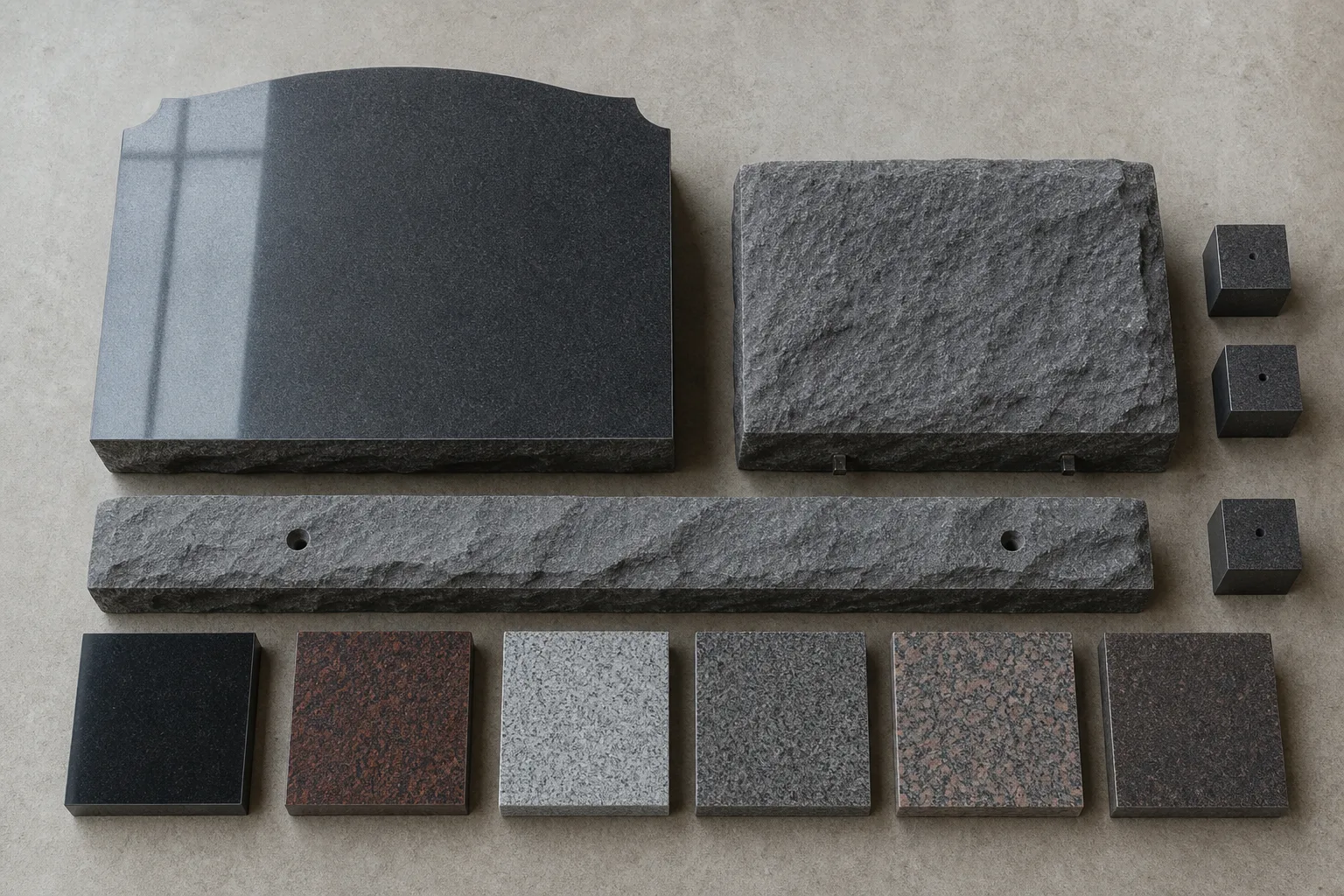
The die is the upright stone; the base is the block it sits on. A quote should state both in inches, width by thickness by height, because a 24 by 4 by 18 die and a 24 by 6 by 20 die are different amounts of granite and different prices. Then check how many faces are polished. Polish two, the front and back, and the cost rises against a stone polished on the front with a rock-pitched top and sides. Color matters as much: standard gray quarries in volume, while black, mahogany and blue-gray do not.
2. Lettering, carving and etching, which are three different charges
Sandblasted lettering is usually included up to some quantity, often the names and dates, with anything beyond it billed by the letter or by the line. Shape carving, a rose cut into the stone with depth and shadow, is a separate skilled operation and priced that way. Laser etching on polished black granite is different again, a photographic image burned into the surface, and it is quoted per square inch or per panel rather than per letter. Ask which of the three your design uses, because a sketch showing all three reads as one drawing and bills as three jobs.
3. The foundation and the setting fee, which the cemetery controls
Most cemeteries require a concrete foundation poured to their specification, and many either pour it themselves or require an approved contractor to do it. That charge may appear on the monument dealer's invoice as a pass-through, or it may arrive separately from the cemetery weeks later. The setting fee, for the crew and equipment that place the stone on the finished foundation, is often a second charge from the same office. Confirm in writing which party bills which, and whether the dealer's quote includes both, one, or neither of them.
4. Delivery, permits and the paperwork nobody quotes for
Freight from the manufacturing plant to the dealer's yard is normally inside the price. Delivery from the yard to a grave two hundred miles away may not be, particularly if the cemetery restricts vehicle access, requires matting to protect turf, or limits installation to certain months. Add the cemetery's permit or monument application fee, which is modest but real. The Federal Trade Commission oversees disclosure practices in the funeral trade, and the same instinct applies here: ask for every charge on one page before you sign anything.
5. The proof, read cold, before the stencil is cut
You will be sent a proof, usually a scaled drawing with the layout, the lettering style and the exact text. Once you approve it, the rubber stencil is cut from that file and the stone is blasted, and granite does not accept corrections. Read it away from the computer, on paper, against a document you trust: a birth certificate, a marriage license, the death certificate. Check spelling, middle initials, the year, the placement of the surname relative to the plot, and whether the design will sit centered once the base is set.
6. The second inscription, years from now
A companion stone often carries one completed side and one side with a name and a birth year only. Adding the death date later is field work, done in the cemetery with a portable blaster, and it costs more per character than shop work does. Ask now what that visit will cost, whether the dealer keeps your layout file and lettering style on record, and who to call if the business changes hands. A note in the estate file naming the dealer, the design number and the lot location saves the next person a long search.
The quote you want is boring to read: dimensions, polish, letter counts, foundation, setting, delivery, and a line for the later inscription. Every number on it should trace to something you can point at.